

The Indiana Hoosiers won the national championship. In football.
I got about halfway into a straightforward writeup of Monday night’s awesome national title game about Fernando Mendoza’s heroic dive to glory on fourth down, how Indiana blocked a punt for a touchdown without even running a punt block play, and whether Miami could’ve landed Mendoza, the Miami-born Cuban-American Heisman winner, instead of Carson Beck, the player who threw an absolutely horrific game-losing interception last night. Maybe you’ll get that newsletter some other day.
But let’s slow down.
The Indiana Hoosiers won the national championship.
In football.
It’s the greatest story in college football history. And I’m gonna savor it a little bit, and talk about why.
– Rodger Sherman

Hoosier Natty

They really did it.
The Indiana Hoosiers went 16-0 and won the national championship. The Indiana Hoosiers. In American football.
Let’s quickly explain why this is the greatest story in college football history before I start crying in the club:
Indiana is the first team to win its first college football championship since Florida in 1996. That’s 29 straight years in which every winner had won before — 29 straight years in which the gate was safely kept.
Indiana entered the season as the losingest team in college football history. It is, by a wide margin, the losingest team to win a championship in our lifetimes. The next losingest team to win a title in what I’d call the modern era of college football is #50 Colorado, which won in 1990. The losingest team to win in the 21st century is #83 Clemson.
Indiana is the first team to win the national title while falling below the Blue Chip Ratio — a metric invented by my former SB Nation coworker Bud Elliott to roughly gauge the talent level of college football teams — since anybody started keeping track. Every national champion since the early 2010s has been comprised of at least 50 percent “blue chip” prospects — i.e., players rated by national recruiting services as 4- or 5-star talents. Indiana’s roster was made up of just 8 percent blue chips.
Teams like Indiana aren’t supposed to win the national championship. Teams like Indiana aren’t supposed to look at the national championship.
You start out life as a sports fan believing in underdog stories. As a kid, you watch a movie where the little guy wins, and as a little guy yourself, you feel as if you’ve won, too. It inspires you to believe that you can do whatever you want in life, no matter what people say.
And then you grow up, and you realize you’re probably not going to do whatever you want. Most people end up within a few standard deviations of the circumstances into which they were born. The bills come on the first of the month, so you get a job that pays them. And when you turn on the game, you don’t see underdog stories. You see the big guys winning and the little guys losing.
College football will beat the dreamer right out of you. It is a sport in which the same teams win every year and people seem to like it that way. I cannot stress enough that if you’re in college football media, people will get mad at you if you suggest that someone new might win. Are they realists dealing with the crushing weight of the status quo? Or are they actively trying to enforce it so that nothing ever changes?
Either way, they are usually right.
College football reinforces its champions and makes life hard for anybody new. When an NBA or NFL team is bad, it gets the #1 overall pick. The only benefit to being bad in college football is that bigger programs will line up to pay you money to kick your ass. MLB fans wax poetic about showing up on opening day believing anything is possible for the upcoming year. In college football, it’s common for teams to win every single game on their schedule and still be left out of the national championship format. Sorry, your wins were less valuable than the losses of prestigious programs like Alabama and Notre Dame. The gaps can feel insurmountable.
As a perennial optimist, I don’t know why I fell in love with a sport so thoroughly devoted to keeping the little guy down, but it has started to eat at me. The past few years were particularly gutting, as the richest and most powerful teams grew unhappy with merely winning all the time and started to make structural changes to box out everybody else. I used to dream about how the sport’s underclass might someday rise up, but that had started to feel like hopeless idealism. It seemed the best anybody could hope for was a good season or two before richer teams hired away their head coach and got their best players to transfer. My fantasies faded.
And then came Indiana.
College football changed Monday night. The self-fulfilling prophecy, that no team could ever win a championship that had never won a championship, is now dead. And it wasn’t a fluke or a miracle. The Hoosiers were the best team in the country all year long, and now they have a banner to prove it.
Yes, some of their success is because of the transfer portal, NIL, and a variety of other recent changes to the sport. In my opinion, it is actually good that recent changes to the sport have led to different outcomes.
But the Hoosiers’ defining trait, more than anything, was a fanatical self-belief. This is not a story of a team that got purchased by a Saudi sheikh or tech billionaire and outspent everybody to get the most sought-after players. The majority of the key players who won the national championship last night are guys Curt Cignetti recruited to James Madison. Many of them joined the Dukes when the team was still in the FCS, the second tier of college football.
The player who blocked Miami’s punt for a touchdown was Mikail Kamara, a high school running back with shoulder problems who was listed as a zero-star recruit, and whose best offers outside of James Madison were from Kent State and Charlotte. (An article about his high school recruitment notes that one of his biggest plays in high school was a blocked punt.) The clutchest catches of the night were made by Charlie Becker, and the game-sealing interception was made by Jamari Sharpe. Both players were recruited by Indiana’s previous coach, Tom Allen, when the Hoosiers were going 3-9 and 2-10 every year. Cignetti liked them enough to get them to stick around.
Of course, Indiana got some talented transfers like Fernando Mendoza, the Heisman winner who is sure to be the #1 pick in the NFL Draft. But as Mendoza noted in his post-game speech, he had dreamed of playing for Miami. The Hurricanes didn’t even offer him a walk-on spot:
Fernando Mendoza calls it a full circle moment after being a 2 star recruit denied a walk-on opportunity at Miami
— CJ Fogler (@cjzero.bsky.social) 2026-01-20T04:25:09.248Z
As Cignetti climbed the coaching ladder from the FCS to the FBS, as he turned Indiana into a legit contender, as more resources became available to him, he could’ve adjusted his process. He could’ve swapped out some of those under-recruited players for consensus studs. But he believed. He believed that his methods were right; that what he saw in those players was real; that he did have an edge in evaluating and developing talent; and that his team was not only good enough to outperform expectations, but to become the best team in the country.
It wasn’t easy. It took the perfect coach and the perfect group players — men who simultaneously value violence and dedication to detail. But they did it.
And if Indiana did that? Indiana? The Indiana Hoosiers? YOUR TEAM can do that. Yes. Your team. It won’t be easy, but it’s possible.
And if a college football team could do this, in a sport designed to prevent this from happening? Maybe we can do it too.
Life feels really bleak right now. Endless structural obstacles can feel insurmountable. The rich are richer and the cruel are crueler than ever. The bad guys are on a winning streak, and it feels like they’re running up the score. It’s hard to imagine a better future when so much effort is necessary just to keep things from getting worse. Dreams are expensive, and rent is due.
For decades, college football has reflected a grim vision of life back at us. It has told us that only a few people get to win, that our fortunes in life are fixed, and if you’re not lucky enough to be Bama, tough luck! Maybe you can make the Gator Bowl every once in a while.
But that’s not why we started watching sports. We got hooked on hope and belief. For years, that seemed naive.
And then Indiana won the national championship. In football. Maybe the rest of us can win, after all.

Sponsored by Homefield Apparel
They really did it

The Indiana Hoosiers won and that is, of course, a win for our friends and sponsors at Homefield Apparel, a brand founded by Indiana football fans inspired by their loss in the 2015 Pinstripe Bowl. (Really!)
I started this brand because Indiana lost the Pinstripe Bowl. Indiana Football is going to the National Championship.
— Homefield (@homefield.bsky.social) 2026-01-10T03:55:28.443Z
Homefield founder Connor Hitchcock had an Indiana national championship jacket in the stadium ready to go. The rest of us can pre-order Indiana national championship gear here today:
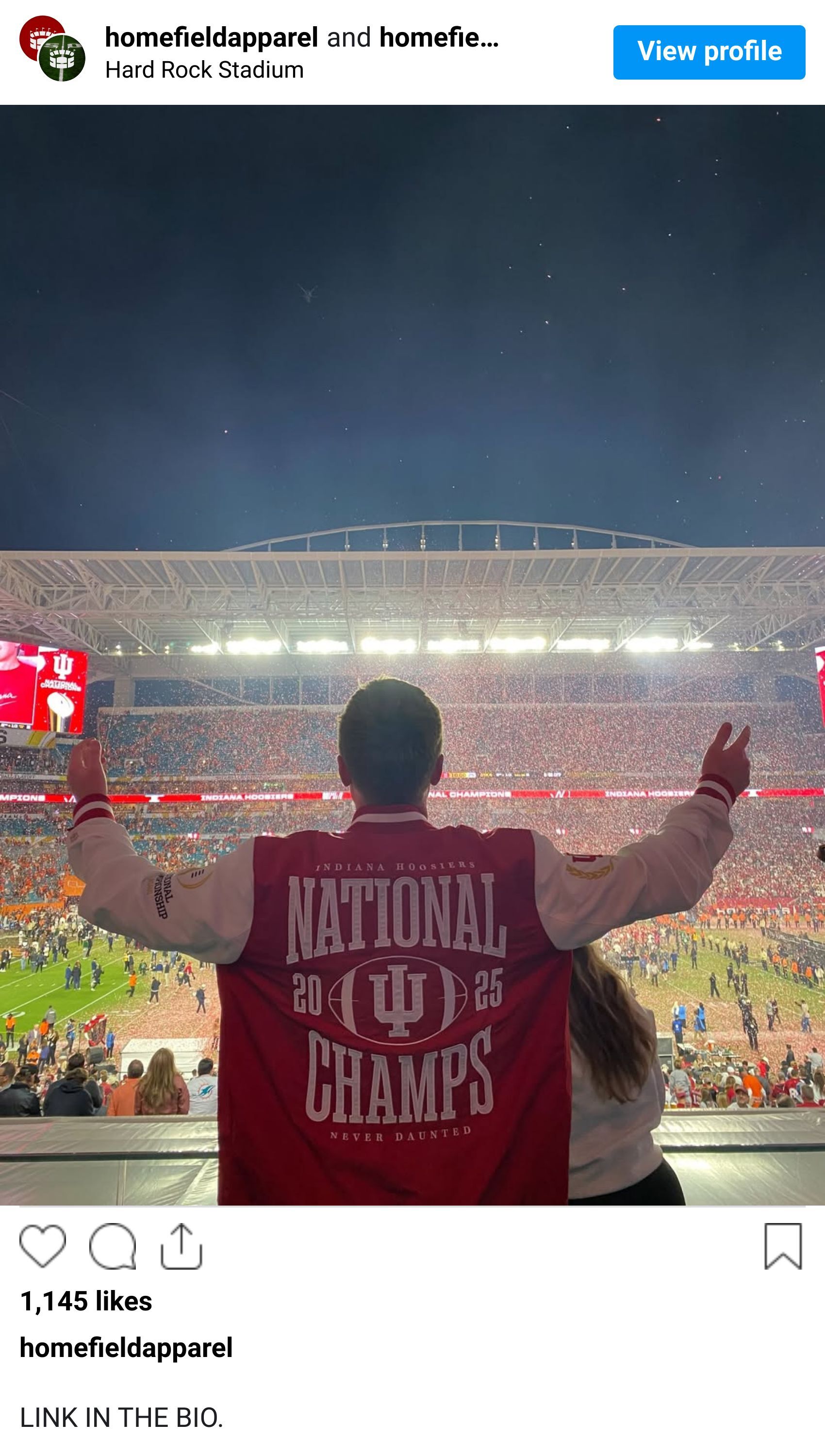
(I bet he woulda felt kinda dumb walking out with that thing neatly folded up if Miami had won.)
It’s a good time for Homefield, obviously. I saw Connor on ESPN’s pregame feeds, and the company got a writeup in The Athletic detailing how it has quintupled its Indiana sales over the last two seasons.
To be honest, Homefield did what Indiana did. A ton of companies make college sports clothing, some of which are worth billions of dollars. But Homefield decided to make higher quality college sports clothing that looks better and feels better. It wasn’t easy — they almost went bankrupt — but they did it.
I feel like a bit of a dweeb typing out a sincere message about a corporation, but since we’re being really real here today: College football media would be poorer and worse without Homefield Apparel. They’ve backed all sorts of projects — from podcasters, creators, and, uh, me — to support an independent college football ecosystem that might not exist otherwise. It’s good to see good things happen to good people, especially when you know they’ve helped a lot of other good people make good things happen, too.


I made a heck of a lot of Indiana content over the last week. Thankfully, the Hoosiers won the title so you can still read, watch, and listen without wondering why I’m getting hyped about the runners-up.
First up, one final push for the video I made about Indiana’s rise from the losingest team in college football to the national championship.
Someday, Northwestern will rise.
I also wrote this piece for The Ringer about Curt Cignetti’s case for the greatest coaching performance of all time. I compared what Cignetti has done at Indiana to turnarounds from the Premier League to the WNBA:
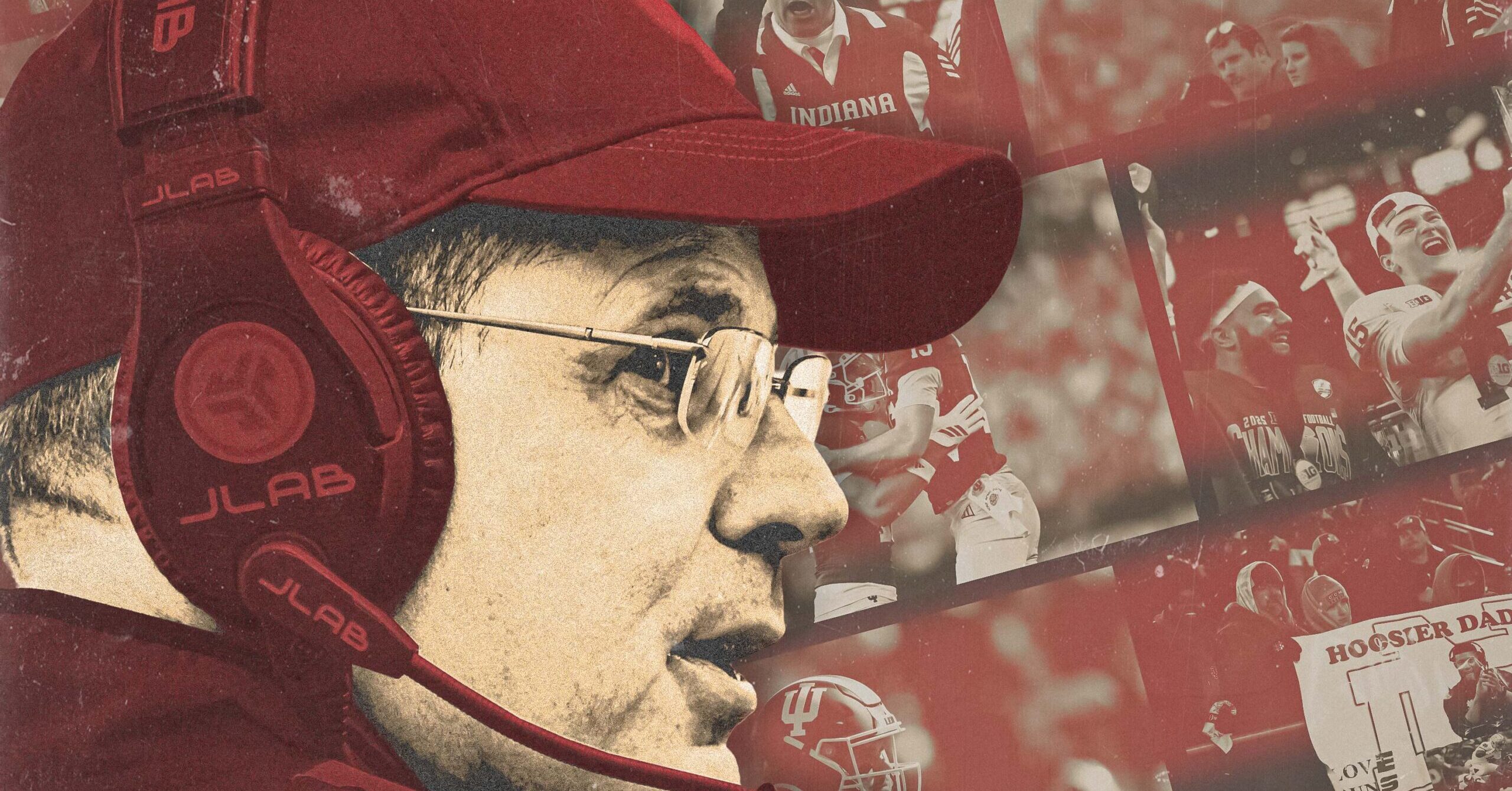
Needless to say, Cignetti’s case is even stronger now that he’s won the national title.
And I did this podcast with our friends at Split Zone Duo about Cignetti’s pre-Indiana career. We Googled him, as he requested.
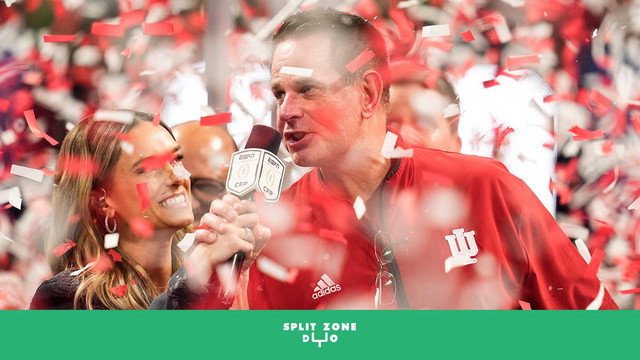
The premise of the episode is that schools are probably going to try to hire The Next Cignetti, which is a fool’s errand. He’s one-of-one! But I do think there’s something to learn from his story. He picked up a diverse set of skills along an unconventional path, blending experience working with the sport’s most celebrated coaches with time spent figuring out how to win at the lowest rungs of the sport. I earnestly think there are better coaches to be found that way than seeking the latest protégé of the guy currently winning.


College football season is over. After five months of weekly college football newsletters here, you won’t be getting one next week, or the week after that. And we’ve only got two more NFL gamedays — Championship Sunday this week, the Super Bowl in a few weeks — so I’m almost out of NFL newsletters, too.
HOWEVER.
You know how the name of this newsletter is “Sports!” and not “Football!”? It’s time for me to start writing about some of those other sports. The Winter Olympics start February 6th. More details to come, but I’ll be writing a ton about the Winter Games to let you know about all the sports you haven’t watched in four years.
Needless to say, I am in my feelings this morning. But whatever, let’s roll with it: I really want to say thank you for being a part of the first college football season here at Sports!
As you probably know, I left a good job a few years ago to go independent. Gotta be honest: At times, that has felt like a poor decision. I have doubted myself a lot — whether I was making the wrong choices, whether I was Good Enough to cut it, etc.
But in the last few months, I’ve really started to believe in what I’m doing. I know where I want to go, I know how to get there, I know it’s going to take a lot of work, but I’m getting the reps in.
And while I kept telling myself that … Indiana went out and won the damn national championship.
In football.
If they can do it, so can you, and so can I.
So, from the bottom of my heart: Thank you for reading, thank you for subscribing, thank you for your financial support. We’re gonna make it.
💬 I love reading your comments! Feel free to leave one here.
😎 Enjoy this column? Become a Sports! Enthusiast for $5 a month.
🔔 Was this sent to you? Well then, here’s your link to subscribe.

